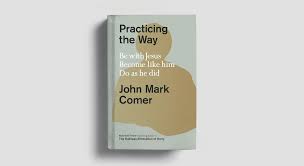
Photo: Practicing the Way website
There has been much discussion online about the Practicing the Way book and resources. Much of the response has been positive, welcoming this approach which introduces old spiritual practices to new generations of Christians. But there has also been criticism – from the mild to the extreme (see this review for example).
What should we think about Practicing the Way? What might it contribute to our faith and Christian growth? And is it worth making use of individually, or as a church community? I first discovered Practicing the Way in January 2024 when I was delighted to stumble across the website. Over the previous few years I’d been exploring the role of the Means of Grace in the life of the Christian, particularly through the thought of Jonathan Edwards.
The Means of Grace (which is my preferred term for spiritual disciplines, or what John Mark Comer calls ‘The Practices’) have had a bad press in some circles because of the danger of misuse, including being used legalistically. But I was already persuaded that, rightly used, they have an important role to play in the life of the Christian and the local church.
I started my exploration of Practicing the Way through the podcasts (there are several podcasts for each of the Practices .) I then moved onto the book, and finally the course which as a church we worked through in our small groups in summer 2025.
Complementary resources
A quick look at the website reveals that Practicing the Way consists of several complementary resources. The ‘foundation’ is provided by the book and the course (which loosely follows the structure of the book over 8 sessions). We are introduced to key concepts such as the importance of intentional discipleship; the nine Practices; and forming a rule of life. In addition, there is the opportunity to explore each of the Practices in more detail through shorter courses (designed to be completed in community); and also a number of podcasts. As we might hope and expect, each of the resources is professionally produced and well presented. For the remainder of this article I will focus on the Course, since this is where many churches will start.
The Course
The first two sessions of the Course helpfully show us that everyone (Christian and non-Christian) is being discipled, or following someone. The question isn’t so much are we being discipled; rather, who are we being discipled by, and are we aware of it?
We are shaped by a number of things working together: Our habits; our relationships; the stories we believe; our environment; and our experiences, all being worked out over time. As Christians, we should be seeking to grow as disciples of Jesus, through Being with Jesus; Becoming like him; and Doing what he did.
The third session builds on all of this to show how we can intentionally grow as disciples of Jesus: Forming godly habits through The Practices; building relationships in Christian Community; believing the real story through the Bible’s teaching; being empowered by the Holy Spirit; all worked out slowly over time and particularly in periods of suffering.
A foundation has thus been laid for introducing the Practices (session 4). The course then focuses in on particular ‘contexts’ in which our formation is worked out – our suffering (session 5) and our sin (session 6) – before bringing everything together in the establishment of a personal Rule of Life (session 7). The course closes by focusing on Community (session 8), the context in which our formation into the likeness of Christ can continue to happen into the future.
Each session consists of a longer video presented by John Mark Comer, some discussion time, and a shorter video introducing one of the Practices. The ‘homework’ between sessions is to get in the habit of working out that specific Practice in real life, and reflecting on how it went before the next session.
Every course has strengths and weaknesses, and here are some of my reflections:
Strengths
Focusing as it does on the Practices / Means of grace, the course deals with core underlying habits of the Christian life that a diet of bible study and preaching can easily overlook, or not address adequately. I have preached for many years, but have never addressed these practices to the extent that the course does. The structure of the course also helps here – introducing a Practice in each session, and giving participants a week to begin to embed the Practice in their own Christian life and in community. The additional Practice sessions and podcasts take this further for those who would value more.
The course also introduces us to some vital truths, such as:
- Every person is being formed – the only question is who or what are we being formed by, and are we aware of it?
- Habits matter, and they change us for good or bad. (In our present cultural moment I might highlight the helpful consideration of the role smartphones play in unintentionally forming habits.)
- Our goal is transformation – to become more like Christ.
- And perhaps most helpfully of all (for me at least): We acknowledge that we can’t change ourselves; but we do what we can (the Practices) to open ourselves to God to do in us what we can’t. I myself experienced that after week 5, considering suffering – as I processed my emotions I found myself forgiving certain people and experienced a profound healing in the process.
Concerns / possible weaknesses:
It would be possible to direct all sorts of criticisms at the course. Some of these criticisms are answered by recognising what the course is trying to achieve, and what it isn’t. For example:
- Scripture is not explained as much as some would like it to be, and those considering leading the course in church small groups might be put off by the absence of any bible study. In our context we adapted the course so that there was a short bible study at the start of each session. The passages and questions are attached at the end of this post in case that’s of any value in your context.
- The course often assumes the core truths of the gospel, and it assumes that those participating are Christians (for example there is no mention of the need to be born again, or the call to repentance and faith). But it is not claiming to be an evangelistic course, and can easily be used alongside Christianity Explored, Alpha etc.
- Connected to this, some might contend that the course focuses on the ‘discipleship’ aspect of the gospels at the expense of the theological categories of the New Testament letters. This is correct, and it may be that some important theological truths are neglected as a result. But having said that, other important theological truths are included that we can sometimes neglect – for example, the clear call from the Lord Jesus to “Follow me” and the call throughout the New Testament to seek in God’s strength to “become like Jesus” (eg 2 Corinthians 3:18).
In my view, these criticisms can be dealt with by ensuring that the course is run as part of a ‘balanced diet’ of discipleship in the life of a church – and in particular, that more in depth bible study is included in that balanced diet.
In other posts in this blog I have written of the need for the means of grace to engage mind / understanding, heart / affections and will. A critic of the course might want to suggest that with the emphasis on habits there is too much focus on will at the expense of head and heart. Having said that, developing good habits with the Practices can be a very good way of engaging head and heart as well. For example, the habit of Bible reading will lead to the mind being filled with Scripture, and the heart and imagination being engaged by what is read.
It could also be claimed that this emphasis on Practices undermines justification and sanctification by grace alone. But again, if we replace the word Practices by ‘Means of grace’ we see this isn’t necessarily the case. The Practices can be the very means by which God brings his grace to bear on our lives: As I have written elsewhere, they are a way of placing ourselves in the river of grace which God has kindly provided for us.
Finally, it might be suggested that the course underplays the role of the local church in the formation of believers. This could indeed be the case if the ‘community’ that one forms is separate from the local church, but this need not be so. Indeed, our local church (or some sub-group of it) is the obvious place to start as we seek to form the community that the course underlines as being so important.
Conclusion
Practicing the Way isn’t perfect – but no course is. As a pastor, I’m not looking for the perfect course; rather I’m looking for resources which, in the right context, will help me and those I care for to grow in faith. And in my view Practicing the Way does that, as part of a ‘balanced diet.’ It could be particularly helpful for those who are new to faith and are seeking to establish healthy patterns of Christian life, those who are seeking a deeper experience of communion with Christ, or those who are feeling stuck in a rut in their Christian lives.
In short, until someone comes up with a course that provides the vital input of Practicing the Way while also dealing with the concerns mentioned above and in other articles online, I for one will continue to use and recommend the Practicing the Way resources, and to thank God for them.
 Imperfect Pastor
this is brilliant Steve. So helpful, balanced, wise and thoughtful. I think you bring a clarity to what the book/course are addressing which some ‘critics have failed to see. And thank you for the helpful addition of a study guide.
LikeLike