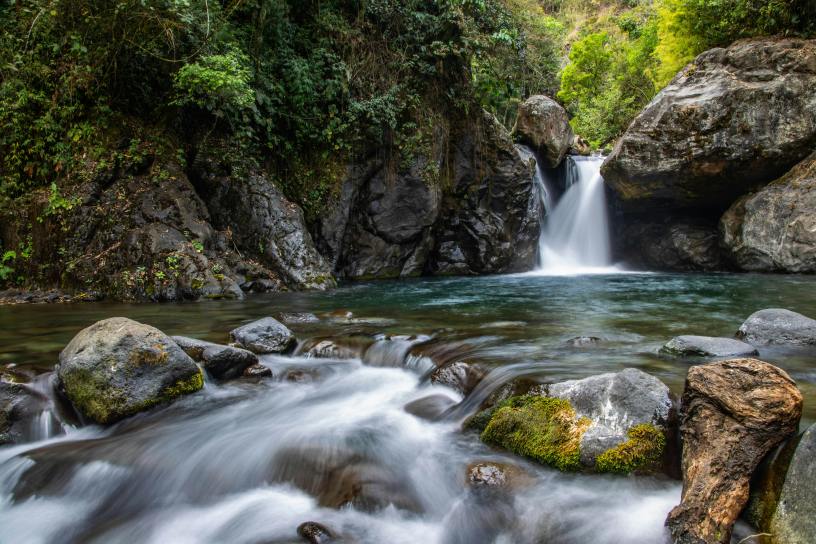
Photo: Diego Madrigal / Pexels
Thirst. Water. They’re universal symbols of need, of life, of satisfaction. Think back to the last time you were desperately thirsty on a hot day, and you received and devoured an ice-cold drink. Picture the relief and satisfaction of your thirst being quenched.
Now consider these words of Jesus:
On the last and greatest day of the festival, Jesus stood and said in a loud voice, “Let anyone who is thirsty come to me and drink. Whoever believes in me, as Scripture has said, rivers of living water will flow from within them.” By this he meant the Spirit, whom those who believed in him were later to receive. Up to that time the Spirit had not been given, since Jesus had not yet been glorified.
John 7:37-39
In this passage Jesus offers himself as the ultimate thirst-quencher – the one who satisfies thirst in a way that no-one and nothing else can. And he says, not only this, but if you come to me you’ll become a spring of living water: you’ll have so much water you’ll give it out to others.
First, a bit of context: Jesus has gone to Jerusalem during the Feast of Tabernacles, one of the major feasts in the Jewish calendar. If you read through chapter 7 you’ll see there are different responses to Jesus: The religious and civil leadership are rejecting him, others are divided.
But here on the last and greatest day of the feast Jesus stands up and offers an open invitation to anyone – whatever their background, however they’ve treated him in the past – to come and drink and be satisfied. Isn’t that wonderful! It’s just like Jesus – that he continues to hold out the offer like this, even to people who are rejecting him. Perhaps you’re aware that you’ve rejected Jesus in the past, or even now you’ve been ignoring him. This passage from the Bible encourages you that it’s not too late – Jesus still offers you this invitation today!
What’s the thirst that Jesus meets?
But what is the thirst that Jesus claims to satisfy? Let’s consider several perspectives on it:
Spiritual thirst – our deepest desire
We all thirst, desiring to be satisfied – physically; and in other ways. God’s Old Testament people were very aware of this when they were in the wilderness back in the book of Exodus. God had rescued them from Egypt with great power, but now they were in the desert, very aware of their physical needs: hungry, thirsty, living in tents. And God provided for their needs.
One of the ways he provided for them is recorded in Exodus 17:1-7. The people were thirsty and they said to their leader Moses “give us water to drink.” Moses prayed to God, and miraculously water poured out from a rock, and they were all satisfied.
The Feast of Tabernacles – which is being celebrated in John 7 – looked back to those events in the wilderness. It was a kind of harvest festival for the Jews, celebrating how God had provided for his people in the past, trusting him to continue to provide – and also looking forward to a day when just as God had provided water in the desert, so he would provide his Holy Spirit to his people. On each day of the feast there was a water pouring ceremony, but this ceremony reached its climax on the final day. Water was carried into the city with great celebration; the priests walked round the altar 7 times and then the water was poured out.
Today we’re very aware that many people in our communities and around the world still live with physical thirst and hunger. And it’s right that as Christians we do what we can to provide for people physically. But the people Jesus is speaking to had physical water; but they were still thirsty – they still weren’t satisfied. The water pouring ceremony proved it. They’re like the woman at the well in John 4 – she had physical water, but there was still a deep spiritual thirst in her.
And Jesus stands up and he says “Let anyone who is thirsty come to me and drink.” Hopefully we can now see that as he uses the image of thirst and water, Jesus is actually talking at another level – about a deep spiritual thirst that is within each of us, and spiritual water which can satisfy it.
Thirst created by wrongdoing and shame
We all do what we know to be wrong. We don’t even meet our own standards, let alone God’s. We’ve done wrong in relation to others, in relation to ourselves, in relation to God. And when we do wrong – that should create a thirst within us, realising that we are lacking in some way – that we are in need.
Sadly, in our culture that sometimes doesn’t happen. We’re sometimes told to ignore our sense of guilt, our sense of shame. But guilt and shame are real; and they’re a blessing, because they show us that we’re spiritually thirsty. Imagine you had no sense of physical thirst – what a curse that would be! You’d never realise you needed water until it was too late and your body shut down. In the same way our guilt and our shame give us a deep thirst. And that’s a good thing, as Jesus says elsewhere “Blessed are those who hunger and thirst for righteousness (for they shall be filled).” (Matthew 5:6)
Wonderfully the Old Testament promises water that brings cleansing from that guilt and shame:
A fountain will be opened to the house of David and the inhabitants of Jerusalem, to cleanse them from sin and impurity.
Zechariah 13:1
I will sprinkle clean water on you and you will be clean; I will cleanse you from all your impurities and all your idols.
Ezekiel 36:25
God is promising a fountain of cleansing: Water which cleanses, which washes away our sin and therefore our guilt and our shame.
As Jesus stands up in the crowd he announces “Let anyone who is thirsty come to me and drink.” Come to me if you’re aware of your guilt and your shame. Come to receive this cleansing, to receive forgiveness and wholeness.
John gives us further explanation of what Jesus means in verse 39:
up to that time the Spirit had not been given, since Jesus had not yet been glorified.
John 7:39
In John’s gospel Jesus is glorified as he hangs on the cross on Good Friday. Why is the cross glorious? Because in his sin-bearing death, Jesus took all our guilt and shame on himself. He took the right consequences of our sin. He made it possible for our thirst to be quenched. Even more than that: he revealed his self-giving loving nature – that we might love him and want to come to him continually, to find our thirst met in him and him alone.
Thirst created by living in a broken world, away from God
It’s not just our own wrongdoing that makes us thirsty: It’s also the wrongdoing of others, and the fact that more generally we live in a world that is broken, hurting, and thirsty. Why is that? We read in Genesis chapter 3 that the world is broken because of humanity’s rejection of God’s good rule. As a result of the first sin the whole world became cursed; hardship and suffering and earthquake and disease came into the world. But deep down we know that we were made for so much more. There’s an ache in our hearts as we look at the world around us: So achingly beautiful; and yet so achingly broken.
Above all we were made for a loving, intimate, joyful face-to-face relationship with God. The first man and woman enjoyed a relationship like that. But after the first sin they were driven away; they couldn’t dwell with God any more. And so we thirst: For justice; for a world that is whole and restored; for an end to shame and suffering. Above all we thirst for relationship with the living God, who is good and loving and who made us for relationship with himself. As one great thinker in the history of the church wrote:
You made us for Yourself, O Lord, and our heart is restless until it finds its rest in you.
Saint Augustine
And it’s into this situation that Jesus says: “Let anyone who is thirsty come to me and drink.” Come to me, believe in me. How does coming to Jesus quench this thirst? Later on in John’s gospel Jesus says
This is eternal life, that they may know you, Father God, the only true God, and Jesus Christ whom you sent … I have come that they may have life, and have it to the full.
John 17:3, 10:10
As we come to Jesus, as we believe in Jesus, so we are brought back into relationship with the God we were made for. And we experience him and his love now in the power of the Holy Spirit. In chapter 14 when Jesus is talking about the Holy Spirit he says “I will not leave you as orphans; I will come to you.” (John 14:18). As we come to Jesus we have the greatest gift already – knowing God. And we can look forward to a day in the future when he comes back and all the brokenness, all the injustice, all the hurt in the world will be removed forever.
Thirst to bring life
We all want to do good and to bring life. And the Old Testament promises that God will send his Spirit upon his people to enable them to bring life. For example:
The Lord will guide you always; he will satisfy your needs in a sun-scorched land and will strengthen your frame. You will be like a well-watered garden, like a spring whose waters never fail.
Isaiah 58:11
What a wonderful promise that is! And as Jesus stands up in the middle of the feast he announces: ‘Let anyone who is thirsty come to me and drink. Whoever believes in me, as Scripture has said, rivers of living water will flow from within them.’
Come to me and you won’t only have your spiritual thirst satisfied – you won’t only have your wrongdoing and your guilt and your shame cleansed you won’t only be brought back into relationship with God – though all those things are wonderful enough. Even more than that the Holy Spirit – God’s agent in the world who brings Jesus’s life to the world – will live in you and will flow from you and so bring life to others through you. You will be as it were a source of life, a life-giving fountain.
Perhaps you have already come to Jesus and you’re thinking “that sounds wonderful, but I don’t feel like I bring blessing to others.” Bishop JC Ryle anticipating that thought, wrote:
The fulfilment of this will not be known until the day of judgement, when we see the amount of good done by every believer… All will be found to have been a blessing to others.
JC Ryle
We might say: if you’re drinking from Christ you are being a blessing to others and giving life – whether you realise it or not.
How do we drink?
I hope and pray that by this point each of us has identified our own thirst and seen our desperate need to drink. And so the vital question remains “How do we drink?” What does Jesus say? “Let anyone who is thirsty come to me and drink.” He goes on “Whoever believes in me.” Drinking is a picture of believing, and of coming to him.
We believe in Jesus and come to him by trusting him; by depending on him; by surrendering to him; by obeying him; by doing what he says. These are all part of believing in him and coming to him. If you’re thirsty on a hot day and you are presented with water you don’t ignore it; nor do you simply stare at it. You might pause to give thanks for it; but then you drink it. And as you drink it you rejoice that it is refreshing your whole body, enabling your body to function properly, and giving you life.
So we drink by coming to Jesus every day. How do we come to him? Let me refer you back to a series of post on the Means of Grace. The means of grace are things like Bible reading, worship, fellowship with other Christians, meeting at church on a Sunday, prayer. Near the start of that series I observed that God’s grace is like a river of grace and spiritual life and nourishment. And the means of grace are the way that we get into the river. We read the Bible, we pray, we sing worship songs, we gather on Sunday as a way of saying “God I’m here; I’m thirsty; I need Jesus; I need spiritual water. Please give me what I need.”
And we come to him with our minds, our hearts, and our wills. We read the Bible to know him and receive him intellectually; but we also allow what we have seen about him to sink down into our hearts – into the depths of our being. We learn to desire Jesus – to desire him more than the other things we desire. We see that he is like honey when the other desires we have are like Marmite (I write this as someone who doesn’t like Marmite – if you do you’ll have to change the analogy!) And seeing that his ways are good for us, we obey him, choosing to do what he commands and finding that it’s for our good. What might that look like for you? How could your spiritual thirst be quenched tomorrow?
And as we enter the river of grace and we ourselves are satisfied, we find that from within us flow rivers of living water. Like a tributary from a great river, we find that we are able to pass on that joy and delight – we are able to bless others and give life to them. Think again of that image from Isaiah 58:
You will be like a well-watered garden, like a spring whose waters never fail.
Isaiah 58:11
We receive from Jesus; and to the extent that we receive we overflow, giving out life to a parched and thirsty land.
Taking it further
Means of grace: https://imperfect-pastor.com/tag/means-of-grace
Practicing the way – John Mark Comer
Daily Bible reading: https://www.anlabychurches.org.uk/z/dailybiblereading80
 Imperfect Pastor