
Part of the village of Anlaby on the edge of Hull, where I minister
This is a talk I recently gave at a couple of gatherings of church leaders in Hull.
The time seemed right to share some reflections on what I’ve learned over the past 12 years as a pastor and would-be church planter here in Hull. Much of what I share will be a confirmation of what you already know. If that is the case please receive it as a reminder – I know I constantly need to be reminded of the underlying principles of faith and ministry!
In some ways the last 12 years have not been a success story in the way the world would define success. We’ve seen people come to faith and grow in faith; we’ve also seen people leave and we’ve had our share of pastoral challenges. So I’m not telling you what you should do; rather, I’m a learner too, sharing some lessons I’ve learned just in case they’re of any use to you.
We’ll briefly consider a couple of passages from Scripture; and then focus on 3 areas.
Keep watch over yourselves and all the flock of which the Holy Spirit has made you overseers. Be shepherds of the church of God, which he bought with his own blood.
Acts 20:28
There are lots of things we could highlight from this passage as the apostle Paul addresses the Ephesian elders for the final time. I want to focus on the first eight words: ‘Keep watch over yourselves and all the flock.’ Notice there are 2 things we’re to keep watch over – first ourselves; then the flock. I’ve found it so easy over the years not to do the first of those; or to think that I’m serving God by only focusing on the second. But actually I’ve found that if I neglect myself I’m not serving God – I’m being a fool.
‘Keeping watch’ incorporates taking care of what you believe – continuing to believe the teaching of the Bible. But it’s also about looking after yourself: For example, taking a day off each week, something I would humbly suggest is essential for ongoing spiritual and physical health.
They devoted themselves to the apostles’ teaching and to fellowship, to the breaking of bread and to prayer. Everyone was filled with awe at the many wonders and signs performed by the apostles. All the believers were together and had everything in common. They sold property and possessions to give to anyone who had need. Every day they continued to meet together in the temple courts. They broke bread in their homes and ate together with glad and sincere hearts, praising God and enjoying the favour of all the people. And the Lord added to their number daily those who were being saved.
Acts 2:42-47
Again, there’s lots we could say. But I simply want to observe 3 directions of relating with a model some of us will have come across before:

We see the early church relating up towards God: They devote themselves to the teaching of the apostles, they break bread, they pray, and they praise God. We see them relating in towards each other: They devote themselves to fellowship, they share what they have, selling their possessions to give to those in need, and they eat together in their homes. And we see them relating out towards the world: Indeed, their faith is so infectious that they enjoy the favour of all the people and the Lord adds daily to the number of those being saved.
These three dimensions of relating are also found in the ministry of Jesus (for example, Luke 6:12-18), and thus there are important for us personally as well as corporately.
Pastoring ourselves – UP
Let’s consider first how we as church leaders and planters relate to God.
I need to find my identity primarily in Christ
This is the single most important thing I’ve learned over the years. In one sense it’s very simple. And yet at the same time it’s the hardest thing – a daily struggle.
Here are some other things we can find our identity in: Our church family; our work; our success or achievements; how we’re viewed by other people – whether it’s church family or denomination or social media or – the list goes on; how we thing we’re ‘performing’ compared to other churches around us. Those things all have their place but if they’re the principal way in which we find our identity, at some point we’ll find ourselves in trouble. Because those things will demand of us too much; and they will let us down. There is only one who loves us completely; who died for us; who invites us to follow him and to be at rest; who has done everything necessary to bring us to heaven regardless of our performance – and that is the Lord Jesus.
How can we cultivate this? I find that the most important thing for me first thing in the morning is to be happy in God. The Psalmist writes ‘Satisfy us in the morning with your unfailing love, that we may sing for joy and be glad all our days.’ (Psalm 90:14). That’s what I need, and what will ready me for whatever the day might hold. And then I find I need to regularly come back to him through the day – to touch base with him as it were.
If our identity is in Christ first and foremost it guards us from being too swayed by all the mess. Because there is mess; there’s lots of it; and there will always be mess before Christ returns. But if I’m happy in Christ then that’s a safeguard for me.
So why not ask God – help me be more satisfied in you than anything else; help me find my identity in Jesus more than anything else. And see what he does!
Here are a few other things I’ve learned in this area of pastoring myself:
Processing emotions
The last couple of years have been particularly difficult for me and for our churches. And I’ve found that taking time to process my emotions is absolutely essential. I realise we’re all different; this may be less important for some. But all of us are whole beings – not just spiritual but also spiritual, physical, psychological, relational as well as emotional. Things can hit us every day that we deal with at a practical level; but we carry in ourselves an emotional response to those things. If we don’t process those emotions they can build up and have the potential to ambush us at some point in the future. So I encourage you to find ways to process your emotions.
Know yourself
Know your particular character and your gifts. What makes you unique in Christ? We’re all different, and it’s so easy to compare and it’s so easy to try to fit into a mould. But I have gifts and character traits that you don’t – why would I try to be the same as you? And you certainly don’t want to try to be the same as me!
So why not ask God – show my myself – who have you made me to be? What are my particular gifts and passions? And who you are making me in Christ?
People you find life-giving
We’re all different, and we’ll find some people naturally life-giving and others naturally draining. (And believe it or not some people find you and me draining!) So make sure you spend time with people who you find life-giving and who support you. Schedule them into you diary. And make sure you have people who will speak into your life in a loving way.
Why not ask God – please show me the people (in my church and outside it) who energise me, and help me make it a priority to spend time with them.
And learn to depend completely on God in prayer, and to surrender to him completely. He is good – total surrender is a marvellous place. Self leads to death; denial of self leads to life.
I might summarise this section with a little phrase I wrote down a few weeks ago. And in a sense whatever happens in my ministry this is enough. This is what I wrote: ‘I’m known and loved; I’ve done my best; it’s his work.’ If you can say that – Praise God!
Pastoring others – IN
People are the priority
‘Keep watch over yourselves and the flock’ – that is the people of God. This is our job – to keep watch over the people. It’s so easy to lose sight of this priority – or to say this is our priority but actually other things take precedence in practice. (For a more detailed analysis see here)
Here are a few other things that have been in danger of taking precedence over the years:
- Buildings – maintaining them, or ensuring they’re maintained.
- Money – ensuring the church can pay the bills
- Filling roles – Jobs needing to be done at church – And how easy it is to view people as ‘resources’ when that’s our focus
- Administration – The constant pressures of emails, policies, meetings…
All those things have their place; but they’re not the priority. And what I’m learning is that if we focus on the priority the other things will follow. What does it look like to focus on people? Here’s one way of thinking about it. (This diagram is adapted from one shared with me by Bishop Eleanor Sanderson, Bishop of Hull):

Working from the bottom, the starting point is Community. People need to know they belong – that they’re loved. This is where Gospel Culture comes in, that we’ve been exploring on this blog: How do we make sure that the culture of our church reflects what we say we believe about love and grace?
As people know they are loved by God and the leadership and the church, they’ll want to grow as disciples. This is the fundamental thing. And this will happen publicly – on in the Sunday gathering for example – but in other settings also. We see in Acts 2 that the early disciples met in homes as well as in the temple courts. There was public teaching by the apostles; there was also more local intimate growing together around the apostles teaching, eating together and prayer. So perhaps the key questions we can be asking are – “How is our church seeking to make disciples? And is it working?”
As we disciple people leaders will emerge and then we’ll be able to explore new forms of ministry. We’ll return to the top of the triangle later.
Teams
Teams are vitally important. We’ve found that we all flourish better in teams. And the key role of the team leader is that the team is spiritually healthy.
And that means that who’s in the team is also important. Depending on the nature of the team and what it’s being asked to do, I’ve found these 5 Cs really helpful in working out who should be on a team, in order of importance:
Convictions – what does the person believe? Character – how formed into Christ’s likeness are they? Chemistry – how will they get on with the other members of the team? Competence – can they carry out the role well? Capacity – do they have the time and capacity?
Wisdom in Leadership, Craig Hamilton
We often focus on Competence and possibly Capacity, and of course they are important; but I’ve found there are other things that are more important.
Other things
We shouldn’t primarily be concerned about building our own church – or dare I say it empire – primarily we should be concerned about the growth of God’s kingdom.
And whatever models of ministry we’ve learned over the years, every context is different and it’s possible we may need to change them – or indeed start again.
Reaching out – OUT
Looking back
The third dimension is looking outwards – reaching out into the wider community – focusing particularly on church planting and forming new worshipping communities.
I’m increasingly convinced that church planting is one of the best ways of reaching out to our lost world. There’s lots of evidence that if it’s done well it benefits the wider community, it benefits the planting church, and it benefits other churches in the local area.
Looking back, at the Anlaby Churches we carried out what was effectively a ‘traditional’ church plant back in 2013: As part of a new service structure we started a contemporary service at St Mark’s Church at 4pm. That service lasted 10 years and there’s no doubt God used it and worked through it, and I give thanks to God for it.
But as I look back I think the biggest weakness of the new service was that there wasn’t a large enough committed planting team for the particular kind of church plant we had in mind. I think we can also say that there wasn’t enough focus on looking outwards, to the local community.
It’s also worth saying what a blessing it is to be able to work with others who have similar priorities. In my context it’s been wonderful to be involved with Hull 2030: To be able to meet with others from different denominations and groupings concerned about the same things, to grow in partnership, to trust each other. And also when it’s been hard for me in my situation, it’s been wonderful to hear how God is working in other churches and other parts of the city – to feel that we’re part of something bigger that God’s doing, growing his kingdom in Hull.
Looking forward
At St Mark’s we’ve started thinking of ourselves as a missional community (see the appendix below). As the name suggests the emphasis is very much on community and on mission or outreach – as well as on discipleship. And ideally it’s lay led – or at least lay people have a very significant role in its leadership.
We’ve gone in this direction for a number of reasons, but it’s worth saying I believe that if we’re going to reach England with the good news of Jesus we will increasingly need to be moving in this direction. There’s a large body of research into why these lay-led missional communities are a vital part of an overall strategy to reach England.
Appendix
What is a missional community?
A missional community is a community of Christians, usually of between 20 and 50 people, who are intentionally focused on mission and discipleship.
They are often linked to a larger church family with whom they meet from time to time to celebrate what God is doing and encourage one another. The community is characterised by 3 key things (diagram again shared with me by Bishop Eleanor Sanderson):
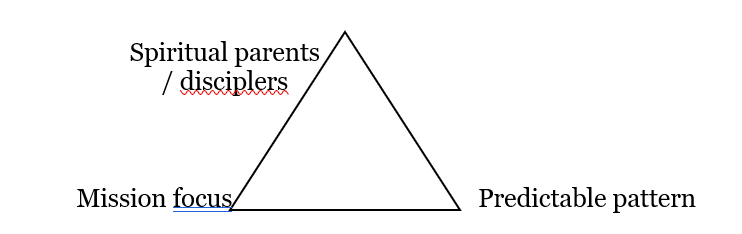
The driving force behind the missional community is the huddling of the leaders (and through them the whole community), through meeting regularly and asking the 2 core questions: “What is God saying to you?” “What are you going to do about it?”
Other key principles are: The community is dynamic, constantly asking God how they should be developing; the community is always seeking to multiply / to begin new communities; new leaders are developed through discipleship; the community is lay-led; underlying the community and movement are low control and high accountability (through the huddle).
 Imperfect Pastor