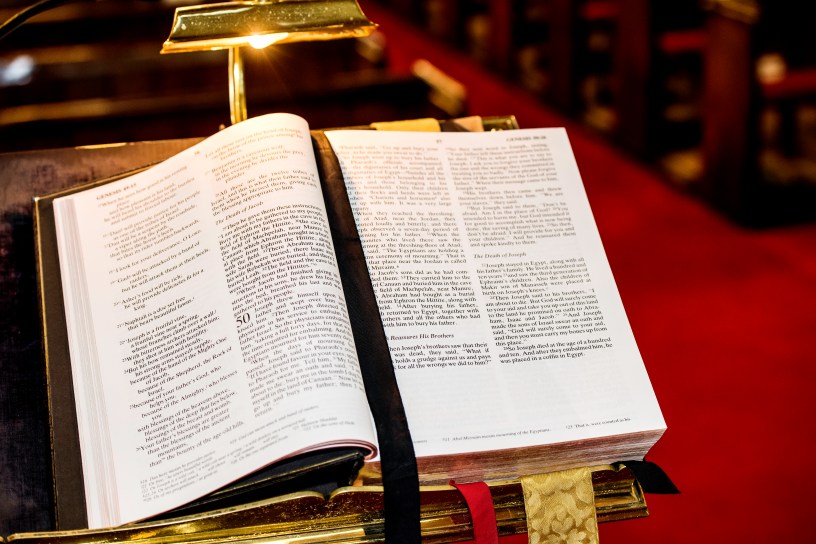
Photo: Inside one of the church buildings where I minister
I am a vicar in the Church of England. I haven’t said much about this so far on my blog. But as an Imperfect Pastor I am embedded in a church, a community, a city, a region, a denomination. So it seems appropriate to comment on what is happening from time to time – particularly given the significant point in church history we appear to have reached, and the great weakness I and many others feel from a human perspective.
With that in mind I’m publishing an open letter:
An open letter to someone thinking of leaving the Church of England
Dear brother / sister in Christ and in our common faith,
You have heard in the news that General Synod has voted in favour of same-sex blessings. You may have seen people writing on social media that any self-respecting evangelical Christian can no longer be part of a Church of England congregation. You have spoken to friends at other churches who wonder why your church hasn’t disaffiliated yet. And you’re torn. Wouldn’t it be easier just to walk away?
I write to you as someone who has thought those things myself – many times. I have been following events closely for a number of years. A few years ago I was on the verge of thinking I should leave. Strangely, I’m more committed to staying in the Church of England at this moment in time than I have been for a long time. Let me give you some reasons why.
1, Belonging to your local church family
Let’s start with your local church where you are a member. Please don’t underestimate what that means. These are the people with whom you have laughed, cried, worshipped, grown in faith over recent years (and perhaps longer than that). They are your church family.
And Church of England ecclesiology supports that. As Article 19 states,
The visible Church of Christ is a congregation of faithful men (and women), in which the pure Word of God is preached, and the Sacraments be duly ministered according to Christ’s ordinance, in all those things that of necessity are requisite to the same. As the Church of Jerusalem, Alexandria, and Antioch, have erred; so also the Church of Rome hath erred, not only in their living and manner of Ceremonies, but also in matters of Faith.
Article 19 of the 39 articles
Do you see? The main expression of church is the local congregation. Not only that: wider expressions of church may go astray, but when they do they are the ones who have moved.
I take it therefore that you can remain in your local church (assuming it holds to the clear teaching of the Bible on the issues of the day) with a clear conscience. I realise that things can immediately get more messy at this point – “But you don’t know about my church…” – and there’s lots of wisdom available on what to do in your situation. But hopefully you get my point.
2, Unity among evangelicals
Someone said to me recently that they haven’t known this level of unity among evangelicals for the whole of their ministry – which started in the 1980s. The unity which we enjoy is remarkable. This was demonstrated at General Synod (of which I am currently an elected member): Those who argued for holding to the historical, biblical, orthodox position spoke from the breadth of evangelicalism, as well as from the traditional Anglo Catholic tradition. Those named included Bishops, female clergy, complementarians, HTB members, young church planters, charismatics and conservatives; I’m sure there were many more I can’t remember.
This unity has been growing since the Church of England Evangelical Council (CEEC) was re-constituted in 2014 and it has been a joy to behold. We have learned (and are learning) to work together, to bear with each other, to appreciate each other. We’re also learning that the differences between us sometimes aren’t as big as we previously thought.
And we have a voice. A united voice. A significant voice. A voice which began to be heard at General Synod and over the coming months will be heard with greater and greater magnitude. And though we might feel that voice hasn’t been listened to so far – that will change, I have no doubt whatsoever.
3, The future of free speech in England (and further afield)
At General Synod, Andrew Selous, the Second Estates Commissioner, gave a powerful speech. As a ‘link man’ between Synod and Parliament he spoke of some of the tensions he has experienced, and he warned of a possible chilling future. He spoke of experiencing pressure from some members of Parliament to impose same-sex marriage on the Church of England. He also spoke of other MPs coming to him privately to express their traditional, biblical view of marriage; they came privately because they couldn’t face the backlash they would receive if they spoke publicly. (Incidentally you’ll have seen how Kate Forbes MSP fared when she spoke publicly – and I thank God for her courage in continuing to stand; do write to her to thank her).
Mr Selous went on to warn of the chilling effect on free speech and freedom of religion in this country if the Church of England as the established church continues on its apparent trajectory towards same-sex marriage without adequate provision for those who cannot in conscience accept it. He warned that in the end it wouldn’t just affect the Church of England, but every church, every workplace, every meeting place. I wouldn’t be surprised if it affects every home as well.
I wonder if you’ve realised that the future of the Church of England is that important?
4, Unity with a ‘re-set’ Anglican Communion
Then there’s the Anglican Communion – a worldwide network of Anglican ‘provinces’ connected by a common faith and history. I don’t know if you’ve seen the recent announcement by the Global South Fellowship of Anglican Churches (GSFA) – you can find it at thegsfa.org. They represent 75% of Anglicans worldwide (and they have significant overlap with GAFCON).
They have announced that they will be ‘re-setting’ the Anglican Communion as a result of February’s vote. They have also announced that they will look at offering alternative episcopal oversight to those in the Church of England who cannot accept the current direction of travel of the Church of England. It seems to me that in the very near future there will be Church of England Anglicans serving under the oversight of orthodox Bishops – whether or not the Church of England Bishops allow it. And wouldn’t it be wonderful to be in restored, joyful fellowship with Anglicans around the world, worshipping the same God in our variety of ways but according to the same common faith?
5, God’s not done with the Church of England yet
I’ve left the most important reason until last – God’s not done with the Church of England yet. How could he be, when there are so many good people still involved? How could he be, when it retains its historic, biblical foundation (even though a few current members are trying to blur things)? How could he be, when the unity that is being expressed among many, and the work being done in so many communities, brings so much glory to his name? No – God’s not done with the Church of England yet.
He loves the Church of England, and he loves your local church: he loves them far more than you and I do. He’s got this. He’s got all of it. And he’s going to work it out for our blessing and his glory.
Where do you fit in?
Of course, if the Church of England continues on its current trajectory it’s inevitable that some form of visible differentiation will be needed. How will that come about?
That’s where you come in. You may feel you cannot make much of a difference – that you don’t have a voice. That’s not true. As a recent publication by CEEC makes clear, ‘Every voice matters’ – including yours. So can I plead with you to stay – for now, until July at least (when the next General Synod takes place). Stay, and make your voice heard, and support your local church which really needs your support right now. Support your local vicar and wardens and PCC who are struggling under the burden and need all the support they can get. And join the chorus of voices rising to heaven in joyful, confident song, praising God for what he’s started and what he’s going to finish.


I hold a conservative rather than revisionist theology and I’ll be staying. I have multiple reasons. Local mission and also that even if ministers choose a revisionist view (some do, because they don’t think the scriptures ever address life long same sex relationships) – all other things we may agree on: Especially that Jesus is Lord and Saviour.
I’m not giving my real name because in my setting I can’t even talk with orthodox members of the church about why other Bible believing christians think differently. Free speech cuts both ways.
LikeLike
Amen!!! Let us praise the name of Jesus our Lord, for the church of God will continue to match on and the gates of hell will not prevail. Thank you so much for writing this article. It’s been a difficult time to understand why the CofE is moving away from the love of God that Jesus sacrificed his life to save us, the biblical modelled life and orthodox views.
LikeLike
Thank you for this encouragement.
LikeLike